Garage Door Repair Hugo MN › Guides › Rollers Explained
Garage Door Rollers Explained: Steel, Nylon and Their Lifespan
A garage door has 10 to 12 small wheels called rollers riding in its tracks, and they are usually steel or nylon. Clopay, the manufacturer, recommends nylon for the smoothest and quietest ride; steel is more durable but louder. How long either one lasts comes down to one spec more than the material: how many ball bearings it has.

Two materials steel and nylon
Bearings matter most more balls, longer life
10,000 to 25,000 cycles typical rated range
Sourced Clopay, Amarr and retail spec sheets
Three signs your rollers are the problem
Should garage door rollers be steel or nylon?
Clopay’s own components guide puts the trade-off in one line: "steel rollers are more durable but can be noisy, while nylon rollers are quieter and require less maintenance." Elsewhere, Clopay goes further and names a preference: it "recommends a high-quality nylon roller for the smoothest and quietest operation." Amarr’s glossary describes rollers more generally as "steel and nylon, usually with ball-bearing wheels that allow sections to roll freely along door tracks," without picking a side.
In practice the split is simple. Steel wins on raw toughness and is the cheaper default on many builder-grade doors. Nylon wins on noise, which matters most when the garage sits under or beside a bedroom, and on upkeep: Clopay’s maintenance guide calls for lubricating steel rollers annually with a silicone-based lubricant but lists nylon rollers as the exception that doesn’t need it. Clopay’s Pro Lube spray is labeled safe for both materials when a roller does need it.
What actually determines how long a roller lasts?
Material is the headline spec, but the number of ball bearings packed into the wheel is what the retail spec sheets actually rate for cycle life. A typical sealed nylon roller sold as a direct replacement part lists 13 ball bearings, a 4-inch stem, a 1 13/16-inch wheel and a 125-pound-per-roller capacity, rated for 25,000 cycles. A common steel roller, by contrast, is sold as a 3-inch steel-tire wheel with 10 ball bearings and a 9-inch stem, with no cycle rating published on the retail listing at all — which is itself telling: unsealed steel rollers are typically rated well below sealed nylon ones.
Independent garage door company guidance (not manufacturer-published, so treated here as third-party estimates) puts rough numbers on that gap: a nylon roller with 13 sealed ball bearings is commonly cited around 20,000 to 25,000 cycles, a 10-ball nylon roller around 10,000 to 15,000, and an unsealed, builder-grade steel roller around 10,000 cycles — which one source translates to roughly seven years on an average household door. A plain plastic roller with no ball bearings at all is the shortest-lived option, sometimes cited at only two to three years, and isn’t something either manufacturer recommends as a replacement part.
| Roller type | Typical bearings | Cited cycle life | Source |
|---|---|---|---|
| Plastic, no bearings | 0 | ~2-3 years (shortest-lived) | Third-party trade guidance |
| Steel, unsealed | 7-10 | ~10,000 cycles (~7 years average use) | Retail spec sheet + third-party guidance |
| Nylon, 10-ball | 10 | ~10,000-15,000 cycles | Third-party trade guidance |
| Nylon, sealed, 13-ball | 13 | ~20,000-25,000 cycles | Retail spec sheet + third-party guidance |
Cycle counts are manufacturer/retailer spec-sheet figures and independent trade-source estimates, not a lab-tested guarantee for every door. A “cycle” is one full open-and-close. An average household door runs roughly 1,500 cycles a year, so the gap between a 10,000-cycle and 25,000-cycle roller is the difference between a replacement every six or seven years and one closer to fifteen.
Can you replace garage door rollers yourself?
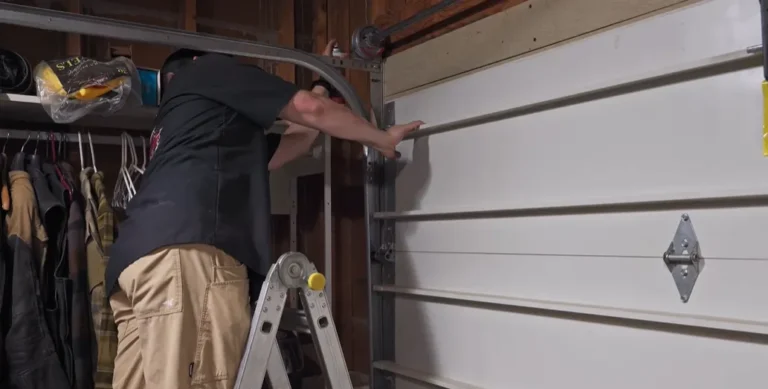
Partly. Clopay lists rollers among the parts a reasonably handy homeowner can replace themselves, following the door’s installation manual. That holds for the rollers running along the middle and top of the track. It does not hold for the bottom two.
| Roller position | DIY or call a pro | Why |
|---|---|---|
| Middle and top rollers | DIY-reasonable | Clopay lists rollers as homeowner-replaceable per the manual; no spring or cable tension involved at these points. |
| Bottom two rollers | Call a pro | They sit in the brackets anchoring the lift cables, which carry the door’s full weight under spring tension. DASMA says bottom brackets should be adjusted or loosened only by a trained technician. |
| Any roller that’s seized or cracked | Stop and call | A roller that slides instead of turning can drag the door out of its track rather than simply being noisy. |
If you’re already checking rollers because of a specific sound, our noise guide matches grinding, squealing, rattling and popping to their most likely part. If the door has drifted crooked rather than just noisy, see one side higher than the other, since that’s more often a cable or spring issue that a worn roller can make worse.
Roller questions
Are nylon or steel garage door rollers better?
Clopay, the manufacturer, recommends nylon for the smoothest and quietest operation, and its own components guide says steel is more durable but noisier while nylon is quieter and needs less upkeep. Nylon with sealed bearings is the common choice for a garage near a bedroom; steel is still a reasonable, cheaper default elsewhere.
How many ball bearings should a garage door roller have?
More is generally better for lifespan. Retail spec sheets show sealed 13-ball nylon rollers rated around 25,000 cycles versus roughly 10,000 cycles commonly cited for unsealed steel rollers with fewer bearings. Bearing count and whether the bearing is sealed matter at least as much as the roller material itself.
How long do garage door rollers actually last?
It depends on the roller, not a single fixed number. Cited cycle ratings run from around 10,000 cycles for basic unsealed steel up to 20,000-25,000 for sealed, 13-ball nylon. At a typical household’s roughly 1,500 cycles a year, that’s a rough range of seven to fifteen-plus years.
Can I replace garage door rollers myself?
The middle and top rollers, yes — Clopay lists them as a homeowner-replaceable part per the door’s manual. The bottom two are different: they’re attached to the brackets holding the lift cables under tension, and DASMA says those brackets should only be adjusted or loosened by a trained technician.
Why does my roller squeak even after I lubricate it?
Lubricant masks a worn roller temporarily but doesn’t fix a flat spot, a cracked wheel or worn-out bearings. If Clopay Pro Lube or a similar silicone-based spray only quiets the sound for a few days, the roller itself needs replacing rather than another coat of lubricant.
Sources
- Clopay — Garage Door Components: A Complete Guide
- Clopay — Garage Door Replacement Parts Guide
- Clopay — Roller Lubrication Tech Sheet
- Amarr — Glossary of Garage Door and Commercial Door Terms
- DASMA — Garage Door Safety Tips
Note: specific bearing-count and cycle-rating figures come from retail garage-door-parts spec sheets (Home Depot/Clopay-branded listing, independent parts retailer listing) rather than a single published manufacturer chart, and the 10,000-to-25,000-cycle comparisons and the 2-to-3-year plastic-roller figure come from independent garage door company guidance rather than a manufacturer source. Both are noted as such rather than presented as manufacturer claims.
Rollers grinding, wobbling or squealing?
Tell us what you hear and how old the door is, and we’ll say whether rollers are the likely cause. Call (651) 217-1271, 24/7.